

Few desserts define the holiday season quite like pecan pie – that golden brown, glossy top giving way to a rich, gooey center filled with toasted pecans and warm vanilla. But in recent years, many home bakers have started asking a new question: Can I make pecan pie without corn syrup?

The short answer: yes – but it’s not always simple. Swapping maple syrup for corn syrup changes more than flavor. It affects texture, structure, and even how the pecan pie filling sets as the pie bakes and cools. Whether you’re aiming for a classic corn syrup pecan pie or experimenting with a maple pecan twist, understanding the science behind each syrup helps ensure your pie stays glossy, sliceable, and perfectly sweet – not soupy or overly sticky. If pecan pie sounds too complicated for you, opt for my simple maple-pecan shortbread bars for similar flavors without the fuss.
The Chemistry Behind Corn Syrup and Maple Syrup
At first glance, both syrups seem similar – thick, golden, and sweet. But their chemistry couldn’t be more different.
Corn syrup is made from cornstarch and contains glucose, which gives it a viscous, sticky texture and prevents crystallization during baking. It’s the quiet hero that holds the pecan pie filling together, giving you that iconic clean slice and shiny finish when the pie cools on the wire rack.
Maple syrup, on the other hand, is thinner and mainly sucrose. It’s less stable at high temperatures, which means it can boil, burn, or crystallize more easily. While it adds a complex flavor – earthy, smoky, slightly caramelized – it doesn’t thicken the same way. That’s why a maple syrup pecan pie often turns out runny, chewy, or even grainy if not adjusted.

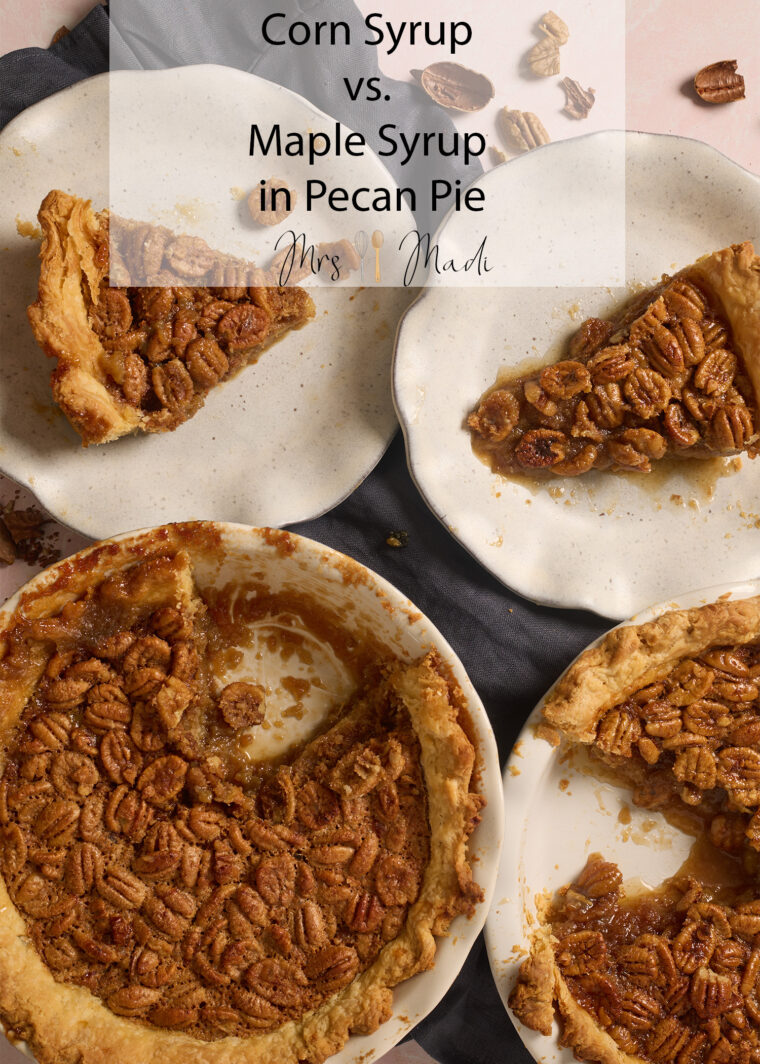
Pecan Pie with Corn Syrup

Pecan Pie with Maple Syrup
Common Problems with Maple Syrup
Many home bakers run into the same issues when trying to swap maple syrup for corn syrup – especially around Thanksgiving, when everyone’s chasing that picture-perfect pie.
If your pecan pie filling turned out runny or loose. In that case, it’s either because you used maple syrup without making the necessary adjustments (it doesn’t have corn syrup’s thickening power) or because the internal temperature of your pie didn’t reach 200 degrees. The filling relies on that viscosity to help the egg mixture set smoothly. Without it, you’ll end up with a filling that never quite gels.
If your pie was overly sweet, you likely didn’t reduce the sugar elsewhere. Maple syrup has a stronger, more pronounced sweetness – beautiful in moderation, but overpowering if used one-for-one with corn syrup.
And that chewy or crystallized texture? That’s the maple syrup reacting at medium heat, where it can harden or burn. Lower baking temperatures and longer times can help, as can mixing maple with a stabilizer like corn syrup or a teaspoon of cornstarch or flour.
Many bakers notice that maple-based pies lack that shiny, glass-like top seen in a traditional pecan pie. That gloss comes from the way corn syrup traps and reflects moisture – something maple can’t replicate on its own.
Corn Syrup vs. Maple Syrup at a Glance
| Syrup Type | Texture & Set | Flavor | Appearance | Best Use |
|---|---|---|---|---|
| Corn Syrup | Thick, gel-like, reliable | Neutral sweetness | Glossy, smooth top | Classic pecan pie |
| Maple Syrup | Thinner, softer set | Deep, complex flavor | Duller, matte finish | Modern, flavor-forward pies |
| Half & Half | Best balance of both | Gentle maple warmth | Glossy but nuanced | Flavor + structure |
Pro Tip: For a 9-inch pie pan, replace half the corn syrup with pure maple syrup, then add 1-2 teaspoons of cornstarch or all-purpose flour to help the pie firm up.

What to Watch For (Doneness Cues)
When baking, the center of your pecan pie should have a slight wobble, not a liquid jiggle. The edges of the pie should look gently puffed, and the top should start to crack. Overbaking leads to a firm, chewy texture; underbaking leaves the filling soupy.
As always, let the pie cool completely on a wire rack for at least 2-3 hours before slicing. Cutting too early allows the still-warm syrup to flow before it can fully set.
Common Mistakes & Quick Fix
Problem: The center is soupy even after cooling.
Fix: Bake 5-10 minutes longer, shielding the crust with aluminum foil to prevent burning. Next time, try a half-corn, half-maple mix or whisk in a spoonful of cornstarch before baking.
Problem: Pie too sweet or maple-forward.
Fix: Reduce brown sugar slightly or use Grade A Amber maple syrup for a milder flavor. Darker grades are stronger and can dominate the pecans.

Smart Tips from the Kitchen
- Toast your nuts. Warm, toasted pecan halves or chopped pecans deepen flavor and help structure the filling.
- Use a blind-baked crust. Whether store-bought pie crust or homemade pie dough, bake until golden before filling – it prevents a soggy bottom of the crust.
- Cool thoroughly before slicing. This allows the filling to firm and prevent the dreaded “pecan slide.”
- Mix gently. Stir until just combined; overmixing can whip air into the filling, creating bubbles and uneven baking.
- For high altitudes: lower oven temperature by 15 degrees F and bake slightly longer for an even set.
FAQ
Can I substitute maple syrup for corn syrup in pecan pie?
Yes, but expect a softer set. Use half corn syrup for structure or add a thickener like cornstarch.
Will maple syrup make my pie too sweet?
Possibly. Maple syrup is naturally sweeter – reduce sugar by 2-4 tablespoons to balance it out.
What’s the best natural substitute for corn syrup?
Cane syrup or brown rice syrup are good alternatives; both offer similar viscosity and are more natural.
Does maple syrup change the flavor?
Definitely – it adds a deep, complex flavor that’s delicious but distinct. Use pure maple for the best results, not imitation syrup.
Can I use dark corn syrup instead of light?
Yes. Dark corn syrup adds molasses notes and a richer flavor, while light corn syrup keeps things neutral and sweet.
The Perfect Pecan Pie
When it comes to corn syrup vs. maple syrup in pecan pie, it’s not a rivalry – it’s a relationship. Corn syrup gives the pie its silky texture and glossy top, while maple syrup adds that complex, caramelized sweetness that feels just a little more special.
If you love that traditional pecan pie, stick with light corn syrup for reliability. If you want something with a modern twist – a maple pecan pie that feels homemade and heartfelt – blend both. It’s the best of old and new, classic and creative, all in one golden, perfect pie.
And when the pie bakes and that top turns golden brown, you’ll know you found your sweet spot – a pie that’s glossy, gooey, and just a little different in the best possible way.


